

Status: Draft, September 21, 2026
The Morphin Grid is usually framed as the source behind every Ranger power. It connects heroes across worlds, eras, and timelines, turning ordinary people into defenders of the universe.
But that raises an uncomfortable question in Power Rangers lore:
If the Grid is simply energy, why did the Psycho Rangers look, fight, and operate so much like real Rangers?
They were not just monsters with similar colors. They were dark counterparts built to hunt the Space Rangers. They used Ranger-like powers, read their opponents’ minds, and exploited the same color-based identities that made the heroes recognizable.
That makes the Psychos more than memorable villains. They may be the clearest evidence for a major Power Rangers theory:
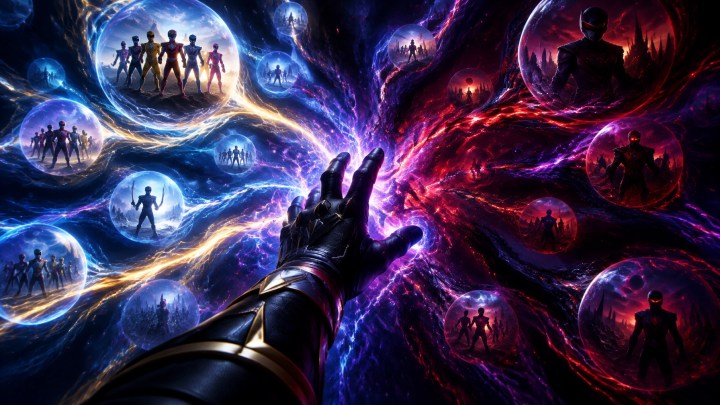
The Morphin Grid does not create heroism. It amplifies the intent of whoever connects to it.
The Psycho Rangers in Power Rangers in Space
The Psycho Rangers debuted during the Saban era in Power Rangers in Space, which originally aired in 1998.
Their story begins in “Rangers Gone Psycho”, episode 31. Astronema creates five evil Ranger counterparts and sends them to destroy the Space Rangers. The Psychos initially appear as impostors, posing as the real team and causing chaos in Angel Grove.
Once their identities are exposed, the Rangers discover that these enemies are not ordinary fighters. The Psycho Rangers are intelligent, aggressive machines with the ability to read the Rangers’ minds. That lets them anticipate attacks and exploit the heroes’ own combat instincts.
Astronema’s plan goes beyond eliminating the Space Rangers. She also intends to use the Psycho Rangers to secretly drain Dark Specter’s life force, weakening him so she can eventually take his place.
That detail is important. The Psychos are not loyal servants acting from simple programming. Their creation is part of a larger power grab. They are weapons, but they are also expressions of Astronema’s ambition, hatred, and desire for control.
The main TV defeats
The Psycho Rangers are defeated through strategy, teamwork, and the heroes’ willingness to fight differently from expected.
- Psycho Pink is defeated in “A Rift in the Rangers”, episode 33. The combined Pink and Yellow Space Ranger attack opens the opportunity for the Mega V3 Missile to finish the battle.
- Psycho Blue falls in “Five of a Kind”, episode 34. The Rangers disguise themselves as Blue Rangers, while Zhane creates further confusion by posing as “Psycho Silver.” The battle ends with the Winged Mega Voyager defeating Psycho Blue.
- The remaining Psycho spirits later return in physical form during “Ghosts in the Machine”, episode 39. They use Astronema’s matter-to-data technology to restore themselves.
- Zhane ultimately tricks the returning Psychos into being trapped as data cards, ending their immediate threat.
The full arc works because the Psychos are not simply stronger versions of the Rangers. They are built around the heroes’ own patterns. The Rangers have to stop fighting as predictable individuals and start thinking as a team.
For fans revisiting the original episodes, Ranger Central’s Power Rangers in Space episode guide provides a useful watch order.

What The Psycho Path Adds to Their Origin
BOOM! Studios’ 2019 original graphic novel, Saban’s Power Rangers: The Psycho Path, expands the Psycho Rangers beyond their TV characterization.
Written by Paul Allor, the story brings Andros and Karone together against the returning Psychos. In this comic continuity, the Psycho Rangers are connected to raw material taken from Astronema’s victims. That gives their existence a disturbing foundation: they were not simply assembled as empty machines. They were shaped from suffering, violence, and the consequences of Astronema’s past.
The book explores several major themes:
- Nature versus nurture
- Whether programmed hatred can ever be overcome
- Karone’s responsibility for the beings she created
- The possibility of family among damaged weapons
- The difference between being created for evil and choosing evil
Karone tries to redeem the Psycho Rangers by teaching them about empathy and family. Meanwhile, Psycho Green wants to build a new family of his own, but his idea of family is still shaped by control and violence.
That makes The Psycho Path especially important to the dark-reflection theory. If the Psychos were created to hate Rangers, then their nature may not be completely fixed. Their original programming matters, but so do their later choices.
Psycho Green and the 1969 Moon story
Psycho Green also has an earlier origin in BOOM! Studios comic continuity.
In that version of Power Rangers history, Psycho Green was originally a Ranger named Trek, the Green Ranger of the Supersonic Rangers. Trek falls under Dark Specter’s influence and becomes Psycho Green after his Ranger power is corrupted.
He later becomes connected to the lost 1969 Ranger story on the Moon, where he awakens during the Apollo 11 era and battles Zordon’s first emergency Ranger team.
This is comic continuity, not TV continuity. The television series never established Psycho Green as a lost 1969 Ranger. That version comes from the BOOM! comics and related stories, where Trek’s fall shows that even an existing Ranger can be twisted into a Psycho.
For more background, BOOM! Studios’ announcement for Saban’s Power Rangers: The Psycho Path introduces the story’s Karone, Andros, and Psycho Ranger setup.
How the Morphin Grid Actually Works, and Why That Makes the Psychos Terrifying
The Morphin Grid is often described as an interdimensional energy field connecting Rangers across timelines and dimensions.
That idea has grown far beyond the original television explanation. Across different stories, the Grid behaves less like a battery and more like a reactive system. It responds to compatible hosts, supports different power sources, and appears capable of connecting people who may never exist in the same timeline.
Some interpretations even treat the Grid as semi-sentient. It does not always feel like a passive force waiting for someone to press a button. It appears to recognize potential, respond to purpose, and connect with people who can carry a Ranger power.
But the Grid may not be inherently moral.
A Ranger can use Grid energy to protect people. Another person could use similar energy to dominate, destroy, or manipulate. The difference may not be the energy itself. The difference may be the person conducting it.
That is where the Psycho Rangers become terrifying.
The Psychos appear to prove that the Grid can be weaponized through obsession and hatred instead of courage and selflessness. Their powers imitate the Space Rangers because they are built around Ranger data and identities. They do not invent a completely separate power system. They corrupt an existing one.
In simple terms:
The Morphin Grid may not make someone good. It may make someone more powerful at being who they already are.
A heroic person becomes a stronger protector. A determined but flawed person may become dangerously rigid. A person consumed by hate could become an unstoppable hunter.
The current BOOM! Studios 2026 Mighty Morphin Power Rangers series by Marguerite Bennett adds another layer to this idea. The new series treats the Grid as part of the fundamental fabric connecting timelines and dimensions. Ten years after the original team leaves Ranger life behind, Billy reconnects the group and reactivates the Command Center when a new threat appears.
That setup reinforces the idea that the Grid is not just a costume-changing device. It is part of the larger structure of existence. If the Grid touches every timeline, then corruption in one place could potentially echo throughout the entire network.
Fan Theory Roundup
Here are four fan theories that build on the Psycho Rangers’ role in Power Rangers lore.
The Dark Signature Theory
The Psychos may have left a permanent corrupted footprint inside the Morphin Grid.
Their powers were built from Ranger patterns, but filtered through hatred and violence. If that corruption remains, it could explain why evil Rangers and dark Ranger counterparts continue to appear across different eras.
The Grid remembers the shape of the Ranger power, even when the person using it has changed.
The Amplifier Theory
This is the central theory: the Morphin Grid is morally neutral.
Ranger colors, weapons, suits, and power sets may only be shells. The person inside determines what those powers become.
That would explain why the same general Ranger structure can produce heroic teams, corrupted Rangers, temporary villains, and morally complicated characters. The Grid supplies potential. The user supplies direction.
The Mirror Theory
The Psycho Rangers worked so well because they were patterned on real Rangers’ data.
That makes them more than evil copies. They may be stolen or duplicated Grid signatures. Their abilities function because they are built from the same underlying information as the Space Rangers.
The Psychos are not new power. They are familiar power reflected through a hostile mind.
The Redemption Theory
If the Grid amplifies intent, then a Psycho Ranger who chooses differently could theoretically become a real Ranger.
The Psycho Path strongly supports this possibility. Karone’s influence helps the Psychos question their programming and consider family, empathy, and choice.
Fans often argue that Karone already proved the concept. She was created and shaped as Astronema, but eventually became a hero as the Lost Galaxy Pink Ranger. Her transformation suggests that origin does not have to decide destiny.

The Real Horror of the Psycho Rangers
The Psycho Rangers are frightening because they challenge one of the most comforting ideas in the franchise.
Power does not automatically make someone noble.
The Psychos wore the colors of Rangers, used Ranger-like abilities, and understood the heroes’ tactics. But they did not share the same purpose. They showed that the appearance of a Ranger is not proof of a Ranger’s heart.
That makes them the Morphin Grid’s dark reflection. They reveal what the power could become when connection is replaced by obsession and teamwork is replaced by control.
The best Power Rangers theory may be the simplest one: the Grid gives people a way to express what is already inside them.
So what do you think?
Is the Morphin Grid truly neutral, or does it have an instinct toward good? Would you want to see the Psycho Rangers return again in a new series, movie, or comic? And could a Psycho Ranger genuinely become a hero?
Drop your own theory in the comments and join the conversation with The Fan Club.
Sources and continuity notes
- Power Rangers in Space episode guide: Ranger Central
- BOOM! Studios: Saban’s Power Rangers: The Psycho Path first look
- BOOM! Studios: The Psycho Rangers return
- BOOM! Studios’ 2026 Mighty Morphin Power Rangers relaunch coverage
TV continuity and BOOM! Studios comic continuity are discussed separately throughout this article.