

Image credit: The Fan Club, AI-generated editorial illustration.
There is no new mainline live-action Power Rangers series waiting for fans this fall.
That reality would have been unthinkable during the franchise’s busiest years. But in 2026, the next chapter of Power Rangers is not being carried by a weekly television schedule. It is being carried by fans.
From cosplay and fan films to custom helmets, short-form videos, comics, tabletop games, and mobile battles, the community is keeping the Morphin Grid active. The franchise may be between major television eras, but it is not standing still.
In fact, this unusual moment may reveal something important about the future of the Saban franchise: Power Rangers has always been more than a show. It is a shared language that fans continue to speak, remix, and pass on.
A franchise between eras
The end of Super Sentai’s long-running television era in 2025 changed the larger tokusatsu landscape. For decades, the Japanese series provided the footage, costumes, concepts, and creative foundation that helped fuel new Power Rangers seasons around the world.
Then came another major blow. The planned Disney+ live-action reboot was scrapped in August 2026 before production began. Reports pointed to the cost of producing a premium superhero series based on an IP Disney does not own.
The result is a noticeable gap:
- No new mainline live-action Power Rangers season is currently leading the brand.
- No new Super Sentai season is supplying a traditional adaptation pipeline.
- The next major television reboot remains uncertain.
But a gap in official programming is not the same thing as a gap in fandom.
For longtime viewers, this is a familiar part of Power Rangers history. The brand has survived changes in networks, casts, studios, tones, timelines, and toy lines. Every era has asked fans to decide what parts of the franchise they want to carry forward.
In 2026, fans are answering that question with action.
The small screen is still active
One of the clearest examples is the officially licensed Power Rangers and Ninja Kidz web project, known among fans as Mighty Morphin Power Rangers Return. Its serialized story runs for roughly 80 minutes across five chapters, introducing new costumes and a separate take on classic Mighty Morphin ideas.
The project has given fans something a traditional television schedule currently does not: a new story to discuss week after week.
Its fifth chapter, which centers on Goldar, even delivers an unusually serious turn for the character. Goldar’s apparent death became a major conversation point because it showed how much freedom a separate continuity can have with familiar Power Rangers lore.
The series is not replacing a full season of television. It does not need to. Its value is in proving that fans will show up for new Power Rangers stories wherever they appear.
A web series can create theories. A dramatic ending can fuel reaction videos. A new costume can inspire a cosplay build. One story becomes dozens of fan conversations, and those conversations become the next part of the experience.
Fans are making the visuals themselves
The most visible side of this movement is the creativity happening outside official productions.
At conventions and online, fans are building their own version of the franchise through:
- Fan films and original ranger teams
- Cosplay and transformation performances
- 3D-printed helmets and custom helmet builds
- Hand-painted props and replica weapons
- Fan art, motion graphics, and video edits
- TikTok nostalgia clips and character tributes
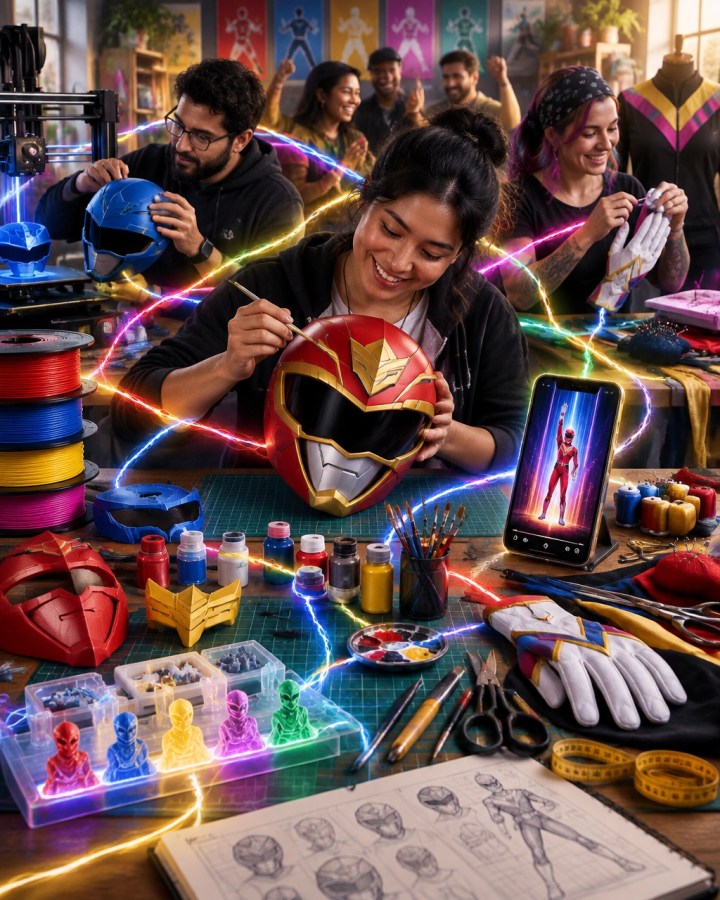
Image credit: The Fan Club, AI-generated editorial illustration.
A finished helmet is not just a collectible. It is a personal statement about which era matters to the builder. A fan film is not merely an imitation of television. It is an argument that the world of Power Rangers still has stories left to tell.
That is especially meaningful for a franchise built around teamwork. The original Saban-era shows were made with television production tools that now look simple compared with modern superhero entertainment. Yet their charm came from imagination, personality, and community.
Fans are returning to those same strengths.
They may not have a studio budget, but they have access to affordable cameras, editing software, 3D printers, digital art tools, and global audiences. A teenager can upload a transformation edit. An adult collector can document a helmet build. A group of friends can produce a fan film and reach viewers around the world.
The tools have changed. The spirit has not.
“It’s Morphin’ Time” never left
Short-form video has become one of the most important places for Power Rangers nostalgia.
On TikTok and other platforms, hashtags such as #powerrangerstiktok bring together transformation edits, soundtrack remixes, reaction clips, toy showcases, convention moments, and memories from the original series.
The familiar “It’s Morphin’ Time” audio continues to work because it is instantly recognizable. It compresses decades of Power Rangers history into a few seconds. A viewer does not need a long explanation. The music, pose, colors, and sound are enough to unlock a memory.
That is the power of nostalgia when it is used creatively rather than passively.
Fans are not only replaying old scenes. They are pairing classic audio with new cosplay, new editing styles, new jokes, and new interpretations of the characters. The past becomes material for the present.
This is why the franchise remains meaningful to adults in their 20s, 30s, and 40s. Many fans who watched Mighty Morphin Power Rangers as children are now the people making videos, buying collectibles, attending conventions, and introducing the franchise to their own families.
Comics are carrying the lore forward
With television in transition, comics have become one of the most reliable homes for new Power Rangers storytelling.
BOOM! Studios has spent years expanding the franchise through alternate timelines, character-driven arcs, crossover events, and deeper explorations of the mythology. Its books have helped demonstrate that Power Rangers lore can support stories aimed at older readers without losing the colorful energy that made the brand special.
The current BOOM! line, including titles such as Power Rangers Prime, gives fans a place to follow ongoing narratives while the future of live action remains unclear.

Image credit: BOOM! Studios.
Comics also offer something television cannot always provide: room to explore.
A comic can spend more time on a Ranger’s doubts, introduce a strange new corner of the Morphin Grid, or revisit a familiar villain from a completely different angle. It can make the franchise feel larger without requiring a new yearly production cycle.
For fans, that matters. The story does not have to stop simply because the weekly show does.
Games keep the team together
Interactive media gives the community another way to participate.
Power Rangers: Legacy Wars continues to bring Rangers and villains from across the franchise together in real-time battles. Its roster-based format turns the entire multiverse into a playable history lesson, allowing fans to build teams that television could never place in the same room.
The game’s official site describes more than 60 playable warriors, including classic Rangers, newer characters, and villains. That kind of crossover is part of the appeal. A player is not just watching Power Rangers lore. They are organizing it, testing it, and creating their own matchups.

Image credit: nWay / Power Rangers: Legacy Wars.
Tabletop gaming offers a different kind of participation. A group can create its own team, write its own missions, and decide what happens next. The franchise becomes a framework for imagination rather than a fixed story.
That may be the most important lesson of 2026: fans do not always need to be given a new adventure. Sometimes they want the tools to create one.
Conventions remain the heart of the community
Online fandom is powerful, but conventions turn that energy into something physical.
At events, fans can see custom suits up close, trade stories about favorite seasons, meet artists, buy comics, play games, and take photos with people who understand why a particular helmet or morphing call matters.
New York Comic Con returns October 8–11, 2026, at the Javits Center. While a dedicated Power Rangers event is not currently listed in the official schedule, the convention still represents what makes fandom durable: comics, cosplay, gaming, collectibles, and thousands of people gathering around the things they love.

Image credit: The Fan Club, AI-generated editorial illustration.
The official NYCC website highlights cosplay, Artist Alley, tabletop gaming, RPGs, exhibitors, and community activities. Those spaces are exactly where Power Rangers fans continue to thrive, whether or not the brand has a major panel.
A convention does not need a surprise reboot announcement to matter. Sometimes the most important event is simply seeing that the community is still there.
The future may be built from the ground up
The current state of Power Rangers is uncertain, but uncertainty can create room for new ideas.
The next major era may not begin with one giant streaming announcement. It could grow through several connected spaces:
- A web series that attracts new viewers
- Comics that expand the mythology
- Games that keep the roster active
- Fan films that experiment with tone
- Cosplayers who make the characters visible again
- Short-form videos that introduce the franchise to a new generation
That is not a replacement for official leadership. Hasbro and future production partners will still have to decide how to move the brand forward.
But the strongest future will recognize what fans have already proven. The most valuable asset in the Saban franchise is not only its costumes, monsters, or theme music. It is the community spirit that turns those elements into something personal.
Power Rangers was built on teamwork. In 2026, that teamwork is happening everywhere.
The show may be missing from the weekly schedule, but the fans are still morphing, building, filming, drawing, playing, and gathering.
The Grid is not empty.
It is being powered by everyone who refuses to let the light go out.
Follow The Fan Club on Facebook for more Power Rangers, superhero, and pop-culture news.